VectorED Network · Audience Assessments
Cooperative Extension
Training Extension educators to communicate vector biology, control, and vector-borne disease to communities across the Mid-Atlantic and Ohio River Valley.
Who We Serve
Each Land Grant institution has an Extension service established by the Smith-Lever Act in 1914. Extension institutions provide research-backed, practical information on agriculture, forestry, livestock, and nutrition, among other topics, to the public.
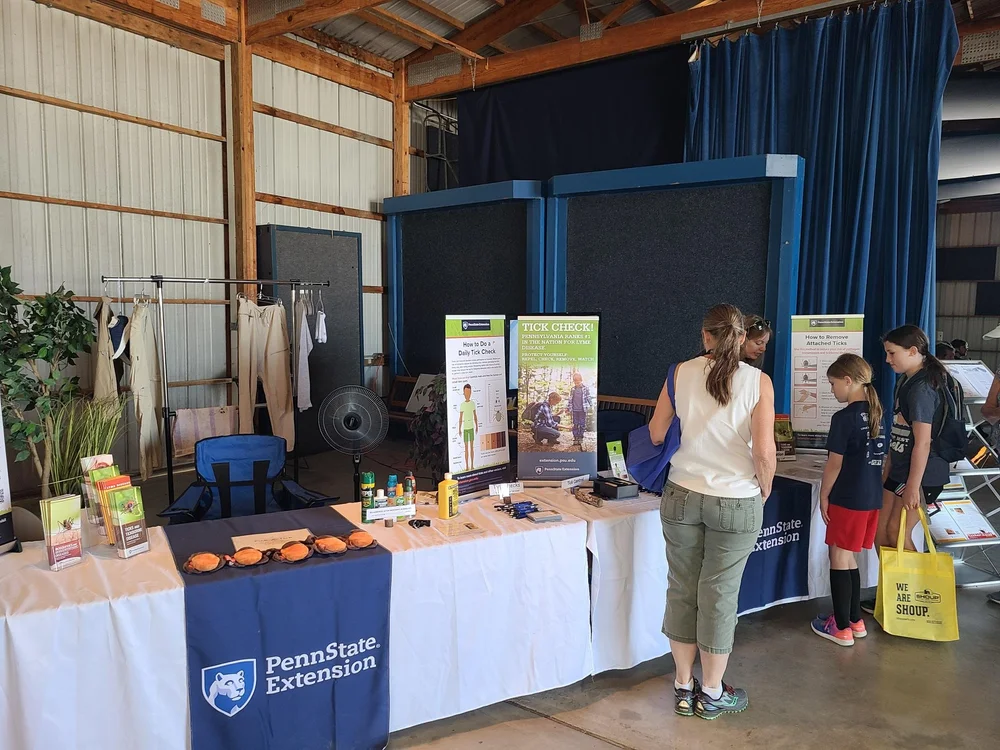
The VectorED Network aims to train and provide Extension educators with information on vector biology, control, and vector-borne disease. We are also working to connect Extension educators with public health agencies, the Centers for Disease Control and Prevention (CDC), and other partners to disseminate vector-borne disease information to a broad audience.
The VectorED Network will utilize Extension's National Framework for Health Equity to provide training and information based on the needs of the communities reaching out to Extension institutions. This includes engaging with communities to identify barriers to optimal health and delivering culturally sensitive and informal programming to promote equitable well-being.
Click to learn more
Our Cooperative Extension Objectives
Develop a working group of Extension educators from Land Grant institutions across our region to facilitate communication and information sharing.
Gather existing Extension materials related to vectors and vector-borne diseases and develop a comprehensive and searchable database.
Distribute needs assessments to Extension educators to determine what resources they and their communities need regarding vectors and vector-borne diseases, and improve information distribution from Extension to public health professionals and other target audiences.
Who Does This Benefit?
Extension Educators, Public Health Professionals & Communities
The overall benefit of these objectives is the creation of a well-coordinated and resourceful network of Extension educators that enhances the management of vector-borne diseases. By fostering collaboration, streamlining access to essential resources, and targeting information dissemination based on community needs, this initiative will ensure that educational efforts are more effective and responsive.
Cooperative Extension Workplan
Needs Assessment Report and Publication
Searchable Database of Extension Materials
Regionally Relevant Educational & Training Tools
Coordination Framework for Extension and Public Health
Project Outputs
VECTOR Library
Explore the Vector Education, Communication, Training and Resource (VECTOR) Library to discover resources on vector identification, risk assessment, personal protection, management strategies, communication approaches, and many other topics related to vectors and the pathogens they carry. Whether you're a health professional, educator, outdoor enthusiast, or concerned about your family and pets, the database has materials for everyone.
Explore the VECTOR Library →Publications
Machtinger, E. T., D. T. Lysaker, I. Chakravarti, O. J. Bognanni, E. D. Struckhoff. The Vector Education, Communication, and Training Online Resource (VECTOR) Library: A Comprehensive Analysis of Vector and Vector-Borne Disease Educational Materials Across U.S. Cooperative Extension. Journal of Extension.
AcceptedLysaker, D. T., E. D. Struckhoff, I. Chakravarti, O. J. Bognanni, E. T. Machtinger. Development of the Vector Education, Communication, and Training Online Resource (VECTOR) Library: A Vector-Borne Disease Education Database. BMC Public Health 26: 1508. https://doi.org/10.1186/s12889-026-27045-5
PublishedChakravarti, I., O. J. Bognanni, D. T. Lysaker, E. T. Machtinger. Informing Regional Extension Approaches to Vector-Borne Disease: Insights from Educators in the Ohio River Valley. BMC Public Health.
Submitted